
The essay
So You’re Raising on SAFEs…
Nobody pitches a SAFE as a big decision. Your lawyer says it’s standard, the investor says it’s founder-friendly, YC wrote the template, and you can close in a week. All true. But a SAFE isn’t one decision. It’s a decision you make three or four times over 18 months, and the trouble is that each one looks small on its own and enormous when they land together.
Here’s the part most founders don’t run the numbers on: the post-money SAFE (the one everyone uses now) locks in a percentage, not a price. The investor who puts $1M in on a $10M post-money cap owns 10% when it converts. Not “roughly 10% subject to dilution from the next SAFE.” Ten percent. Every later SAFE you raise comes out of your column, not theirs.
The Math Nobody Shows You
Say you raise in three tranches, which is a very normal pre-seed to seed path:
-
$1M on a $10M post-money cap. Investor A owns 10%.
-
$1.5M on a $15M post-money cap six months later. Investor B owns 10%.
-
$2M on a $20M post-money cap eight months after that. Investor C owns 10%.
You’ve raised $4.5M and every round felt like “only 10%.” Founders tend to mentally blend this to something like 25% because the caps kept rising. It isn’t 25%. It’s 30%, and Investor A still holds their full 10% because the later SAFEs didn’t touch them.
Now the Series A arrives. $8M at a $32M pre-money, so the new investor takes 20%, plus the customary 10% post-round option pool carved out of the pre-money (see Part 2 if that phrase makes you wince). Your SAFEs convert, and then everyone who existed before the A gets diluted by the A.
Where you land:
-
SAFE holders: 30% before the round, roughly 21% after
-
Series A: 20%
-
Option pool: 10%
-
Founders: 70% before the round, roughly 49% after
You walk into your Series A having sold less than half the company and walk out of it owning less than half. The A investor didn’t do that to you. The stack did.
Three Things That Make It Worse
The cap becomes the price. A valuation cap isn’t a valuation. It’s a ceiling. If your Series A prices below the cap, the SAFE converts at the lower price and takes more than you modeled. A $20M cap on a round that prices at $16M pre-money means Investor C ends up with more than 10%. Caps only protect the investor; they never protect you.
MFN clauses travel. If an early SAFE has a most-favored-nation clause and you later give someone a discount or a lower cap, the early investor gets to take the better terms. One generous side deal for a strategic angel can quietly reprice your whole first tranche.
You’re negotiating with nobody. A priced round has a lead who argues the cap table with you and then defends it. A SAFE round has a dozen checks at whatever cap you could get each of them to accept. Nobody is looking at the whole picture, which means the whole picture is your job.
Final Thoughts
SAFEs are fast, cheap to paper, and they keep you building instead of negotiating. None of that is wrong. The mistake is treating them as free. A SAFE is equity sold at a fixed percentage with no lead watching the cap table, and the bill comes due in one lump at the Series A. Know the number before you sign, not after.
The chart
A $1–2.4M SAFE sells as much as a priced seed
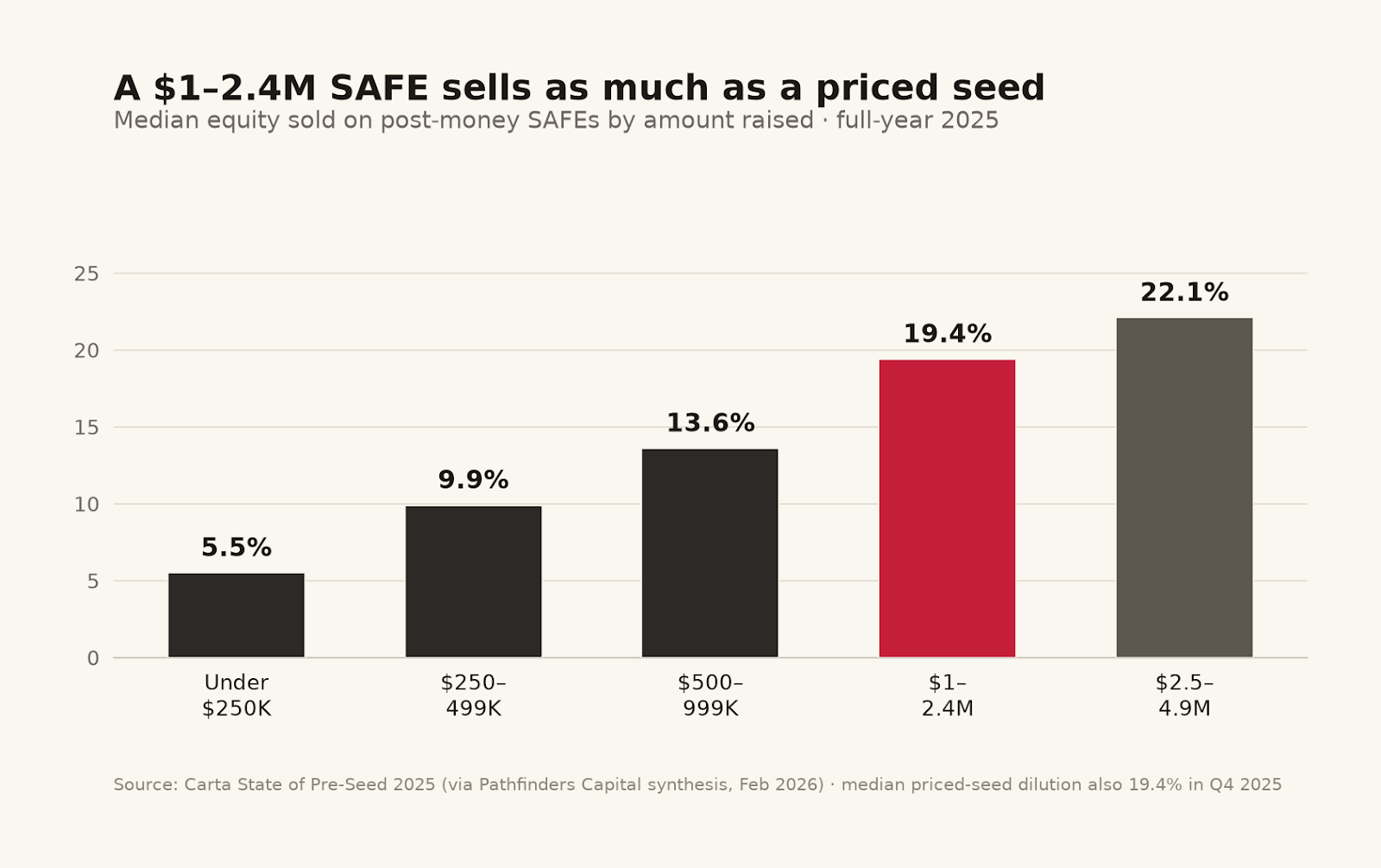
Carta's full-year 2025 pre-seed book puts a number under the thing founders shrug off. Median dilution on a post-money SAFE climbs with check size: 5.5% under $250K, 9.9% at $250–499K, 13.6% at $500–999K, then 19.4% once you're in the $1–2.4M band. At $2.5–4.9M it's 22.1%.
That 19.4% matters because it's the same as median priced-seed dilution in Q4 2025. A "just one more SAFE" at $1.5M is not a free pass around a seed round — it's selling seed-sized equity without a lead watching the table. Stack two or three of those and you've sold a Series A before anyone priced one.
Implication: model cumulative post-money SAFE ownership before you sign the next one. Raise fewer, bigger tranches, and switch to priced once you're past ~$3–4M — which is where Carta says the majority of rounds now flip anyway.
Source: Carta State of Pre-Seed 2025 (full-year; Pathfinders Capital synthesis, Feb 2026). Priced-seed dilution: Carta Q4 2025.
The tactic
Set a founder ownership floor before the first SAFE
Build a cap table that assumes two or three SAFE tranches and a priced round, and pick the ownership you want at the A (most people land between 45% and 55%).
Back into how much SAFE money you can take at what caps. Raise fewer, bigger tranches, and move to a priced round once you're past $3M to $4M.
Ask every SAFE investor what percentage their check converts to on the post-money cap.
Failure this prevents: Prevents walking into your Series A having sold less than half the company and walking out owning less than half.
The rethink
Used to: Each SAFE was a small, separate decision, and rising caps meant each new tranche cost the founder less.
Now: A SAFE stack is one decision made three or four times. Founder ownership at the Series A is mostly set by the stack, not by the A.
What moved: Watching Series A cap tables come together where the founders were surprised to end up under 50%. When we walked back through them, the A investor's 20% wasn't what hurt. It was the 30% in SAFEs that had each felt like "only 10%."
Views are my own, not Alumni Ventures'. Nothing here is investment advice. Deals and companies are anonymized unless already public.