
The essay
So Your Round Is Becoming Real…
If you’re a startup founder, there’s no greater feeling than your first term sheet. You’ve been grinding for 12 months, your friends are starting to wonder if they’ll ever see you again, but it’s all worth it because you finally have a term sheet in hand from a Tier 3 VC. As you read through the docs with your team, you hit a section labeled “Option Pool for Employees.” Seems harmless enough. It isn’t. That one clause shapes your ownership as a founder, your ability to attract talent, and the economics every current and future investor walks away with.
So what is an option pool, and why does it matter? Simply put, it’s a slice of equity set aside to be distributed to future employees, advisors, and other key stakeholders as an incentive. In most cases it’s earmarked for employees and prospective hires, giving them a stake in the company’s upside.
There’s no universal size, but a typical pool runs 10% to 20% of fully diluted shares outstanding (FDSO): the total share count, including all options and convertible securities.
Why Option Pools Matter
Attracting top talent. Equity compensation is how a cash-strapped startup competes with larger companies that have deeper pockets. A pool lets you offer high-caliber candidates a piece of the future when you can’t match the salary.
Retention and motivation. Options align employees’ interests with the company’s success and reward them for sticking around, which fosters a shared sense of ownership over the long haul.
Cost-effective compensation. Early on, cash is scarce. Equity lets you attract and keep people who would otherwise be out of reach, without draining the bank account.
The Nuances of Option Pools
Powerful as they are, option pools come with mechanics worth understanding before you sign.
Note: Option Pools Are Dilutive
The most important thing to internalize: pools are inherently dilutive. As the pool grows, it shrinks the ownership percentage of existing shareholders, founders included.
Here’s a concrete example. You’re raising $5M at a $20M pre-money valuation, and the term sheet calls for an option pool equal to 10% of the post-round cap table, established in the pre-money (i.e., carved out before the investor’s money lands). Two separate things are happening, and it pays to keep them apart:
-
Your investor is buying 20% of the company ($5M into a $25M post-money valuation).
-
The pool has to equal 10% of the final cap table… and it comes out of your side, not the investor’s.
Here’s where you land after the round:
Watch how the dilution actually stacks, because it’s worse than the investor’s 20% lets on. The pool is carved from your pre-money, so it bites before a dollar comes in: reserving a pool worth 10% of the post-round cap means giving up 12.5% of your pre-money company (10 of 80 pre-money units), which takes you from 100% to 87.5%. Then the financing dilutes whatever’s left, you and the pool alike, dropping you from 87.5% to 70%. A round where the investor “only” takes 20% has quietly cost you 30 points of ownership.
The same story shows up in the valuation. Your headline pre-money is $20M, but $2.5M of that is the pool being set aside (10% × $25M post). Your effective pre-money, what your shares are actually worth going in, is $17.5M. The pre-money flatters you by exactly the size of the pool.
Who Actually Bears the Pool
This is the part that trips people up, so it’s worth being precise. The new investor is never diluted by a pre-money pool. By definition it’s carved out before their money lands, so it falls on you and your existing shareholders. In our example the investor wants 20% and gets 20%; the pool’s 10% comes out of your column, leaving you 70%. The pool comes entirely out of the founders in that example.
It’s actually a touch worse than “the investor is unaffected.” Because the pool inflates the pre-money share count, it lowers the price per share the investor pays, so if their check is fixed rather than their target percentage, a bigger pre-money pool quietly raises their ownership. That’s precisely why an investor may push for a pool larger than your hiring plan needs: padding it is, in effect, a discount on their entry price.
That’s why where the pool sits in the valuation is the whole ballgame:
-
Pool in the pre-money (the standard ask). The investor quotes a $20M pre-money but requires the pool to live inside it. Your real value isn’t $20M, it’s $20M minus the pool, or $17.5M. You eat 100% of the pool, and the headline number disguises it. This is the “option pool shuffle.”
-
Pool in the post-money. The $20M pre-money now represents your shares alone, and the pool sits on top. For the investor to still clear their 20%, they have to pay an effectively higher price (i.e., accept a higher real pre-money). The pool only comes off your back by costing the investor. There’s no free version where it simply “dilutes everyone”; someone pays, and moving it post-money is how you make that someone the investor.
Negotiation Levers as a Founder
Once you’re negotiating, founders usually talk about three levers. Be honest with yourself that two of them are the same move:
-
Shrink the pool. Investors often anchor at 15-20%; size it instead to the hires you’ll actually make before the next round, and make them justify anything bigger. Every point you trim stays with you.
-
Raise the pre-money. A higher pre-money offsets the dilution the pool creates.
-
Move the pool into the post-money. Get it sized against a pre-money that’s just your shares, so the cost shifts to the investor.
Here’s the catch: levers 2 and 3 are economically the same lever in different clothes. Both work by raising the effective price the investor pays so the pool stops being entirely yours. Run the numbers and a “$20M pre-money with the pool added post-money” lands you in the same place as “a higher pre-money with the pool inside it.” So you really have two levers: pool size and price.
And be realistic about lever 3: a pre-money pool is the market default, and investors rarely agree to an explicit post-money one. Don’t burn your chips fighting for the label. Spend them where they actually move equity: arguing the pool down to your real hiring plan, and pushing the pre-money up. Same economics, far more winnable.
Final Thoughts
Option pools can feel like a tax on founders, but they’re how you build a team that’s actually motivated to make the company worth something. The goal isn’t to minimize the pool, it’s to size it to your real hiring plan and stay clear-eyed about the one thing that’s always true: a pre-money pool comes out of you, and the price is the only lever that shifts any of it. Get the size and the price right and the pool does its job without quietly carving up your equity.
The chart
Seed employee pools sit at 12.1% — not the 'standard' 20%
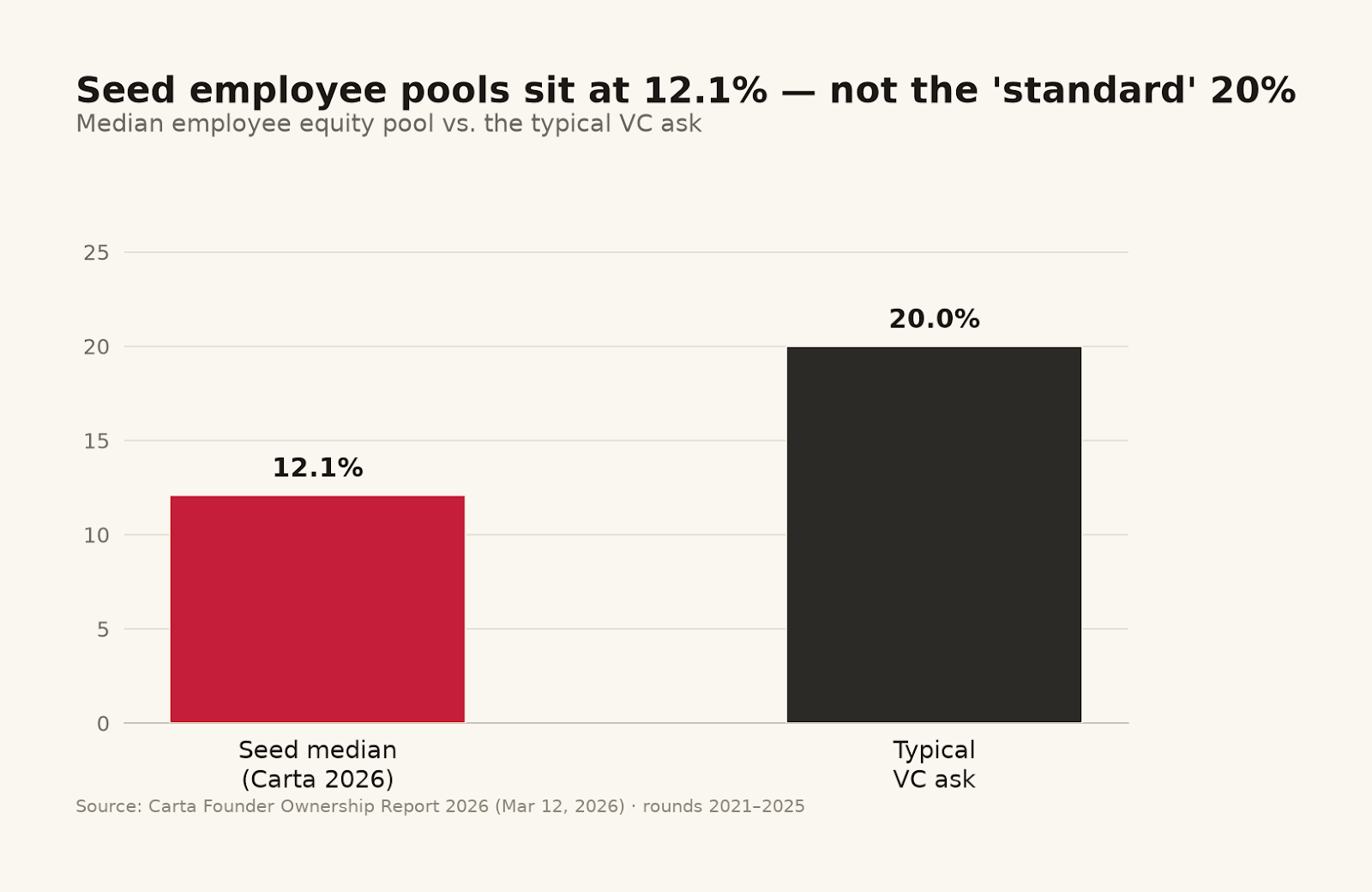
Carta's Founder Ownership Report 2026 is blunt: at seed, the median employee equity pool is 12.1% of fully diluted equity. The "standard" 20% ask still shows up in term sheets — about eight points above what the actual median company runs.
Those points are not free. On a pre-money pool carve-out they come out of the founders before the investor's check hits. By Series C the median employee pool (16.8%) has already overtaken median founder ownership (16.1%). The pool is supposed to hire the next two years of the company, not pad the investor's anti-dilution.
Implication: size the pool to a hiring plan, not a habit. Push back on 20% at seed unless you can point at specific roles that burn that much equity before the next raise.
Source: Carta Founder Ownership Report 2026 (Mar 12, 2026; rounds 2021–2025).
The tactic
Size the pool to your real hiring plan
Before you negotiate, list the hires you'll actually make before the next round and what each one needs in equity.
Use that number to argue the pool down from the 15-20% anchor, and make the investor justify anything bigger.
Spend your remaining chips on the pre-money, not on whether the pool is labeled pre or post. The economics are the same.
Failure this prevents: Prevents an oversized pool quietly cutting your effective pre-money and handing the investor a discount on their entry price.
The rethink
Used to: The headline pre-money was the number to fight over, and the option pool was a housekeeping clause.
Now: There are really two levers, pool size and price. A pre-money pool always comes out of the founders, and arguing about where the pool sits is mostly arguing about a label.
What moved: Running cap tables side by side with founders for each version of their term sheet. A $20M pre-money with the pool added post-money landed in the same place as a higher pre-money with the pool inside it, every time. The only changes that left founders with more were a smaller pool or a higher price.
Views are my own, not Alumni Ventures'. Nothing here is investment advice. Deals and companies are anonymized unless already public.