
The essay
Most founders send investor updates to their cap table. The best founders send them to investors who haven’t written a check yet.
Here’s the problem with the standard approach: by the time you’re running a process, the investors you’re pitching are meeting you cold. Little context. Little conviction. Little reason to move fast. You’re starting from zero when you should be at the finish line.
Sending prospective investors a monthly update (6 to 12 months before you raise) changes the entire dynamic.
Here’s what actually happens when you do it:
-
You compress the trust timeline. Investors back people as much as companies. A consistent update over six months does more relationship work than any pitch meeting can in an hour. By the time you’re raising, they already know your voice, your judgment, and your instincts under pressure.
-
You turn your metrics into a live story. Showing $50K MRR in a deck is fine. Showing a prospective investor that you’ve gone from $20K → $50K → $70K in their inbox over three months? That’s momentum. That’s FOMO. No pitch manufactures what a live track record delivers.
-
You flip the attention dynamic. You stop waiting to be remembered and start becoming impossible to forget… without ever asking for anything.
-
You pre-empt diligence. An investor who’s been reading your updates for six months has already watched your hiring decisions, churn responses, and strategic pivots play out in real time. The “getting to know you” phase is done before the first meeting. That can cut weeks off your close.
What a great update looks like:
Keep it tight. Monthly is ideal. Cover:
-
Key metrics (MRR, growth rate, burn, runway), no hiding, no spin
-
Top 3 wins since last update
-
Biggest challenge you’re navigating (this is where trust is built)
-
What you need: intros, hires, customer connections, or nothing at all
-
What’s next: so readers feel like they’re along for the ride
Final Thoughts
The founders I remember most aren’t always the ones with the best decks. They’re the ones who kept me posted, were honest when things got hard, and showed up to their raise having already done the relationship work.
Start sending updates before you think you need to. The best time was six months ago. The second best time is now.
The chart
Seed → A within two years: halved since 2018
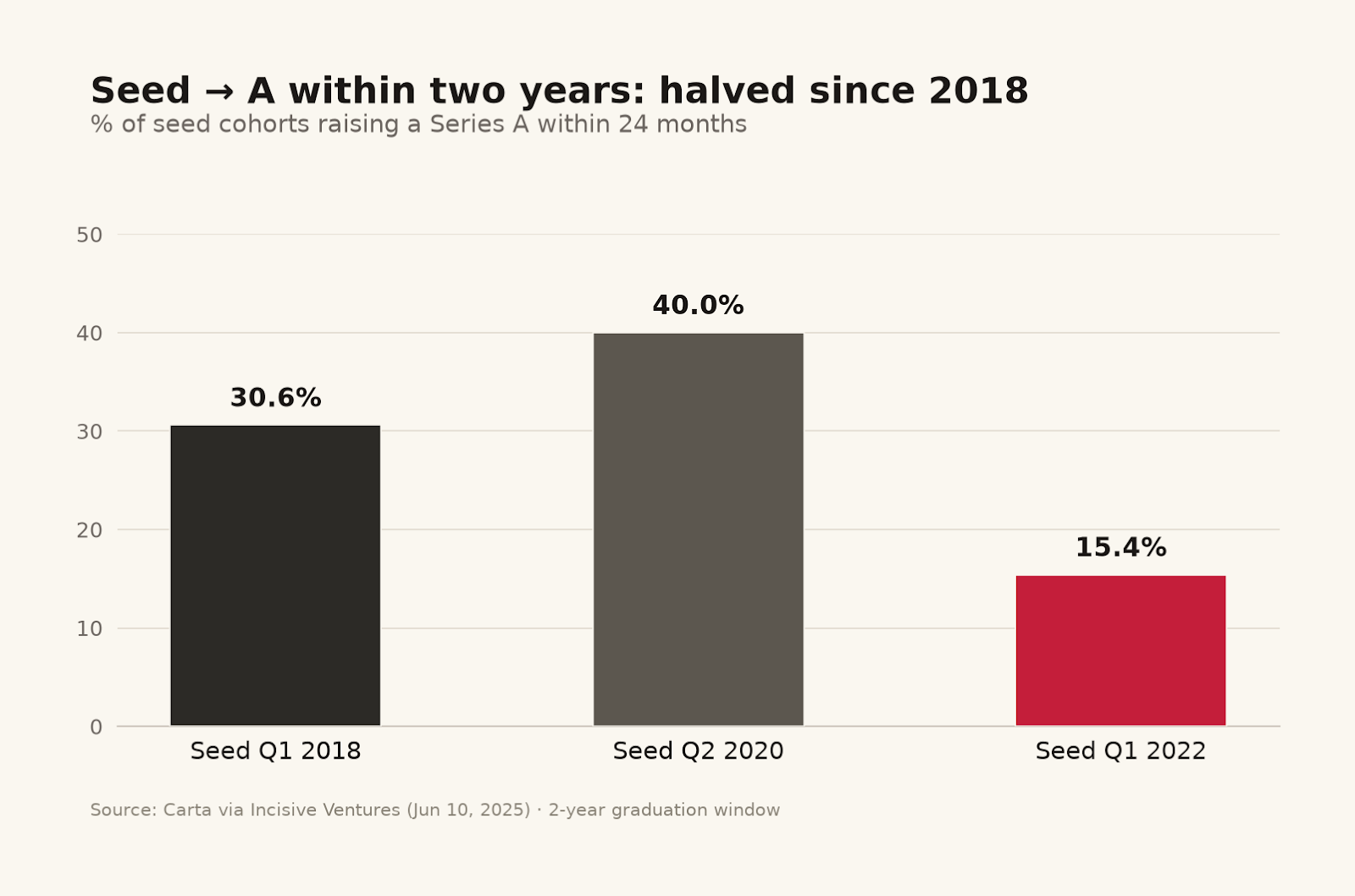
Carta's 2-year graduation window, as reported by Incisive in June 2025: 30.6% of Q1 2018 seeds made Series A within 24 months. The Q2 2020 cohort — raising into the 2021 boom — hit about 40%. Q1 2022 seeds: 15.4%. Half the rate in four years.
The A didn't get easier. It got slower and rarer. Monthly updates are not a courtesy email — they're how you stay in the room while the funnel collapses and bridges eat the calendar.
Implication: start the update cadence before anyone writes a check. The partners who already know your numbers are the ones who can defend you when the A bar moves.
Source: Carta via Incisive Ventures (Jun 10, 2025).
The tactic
Send your monthly update to investors who haven't invested yet
Six to 12 months before you raise, add the investors you'd want in the round to your monthly update list.
Cover key metrics (MRR, growth rate, burn, runway), the top three wins, the biggest challenge you're working through, what you need, and what's next.
Don't ask for a meeting. Keep sending it in the bad months too, since that's where the trust gets built.
Failure this prevents: Prevents starting your raise from zero with investors who meet you cold and have no reason to move fast.
The rethink
Used to: Investor updates were a reporting obligation to the people already on the cap table.
Now: Updates do the most work when they go to investors who haven't written a check yet. Six months of them does a lot of the diligence before the first meeting.
What moved: Comparing raises where I'd been reading a founder's monthly update for months with the ones that came in cold. With the updates, I already knew how the founder handled a bad month, and the first meeting started at the hard questions instead of the introductions.
Views are my own, not Alumni Ventures'. Nothing here is investment advice. Deals and companies are anonymized unless already public.