
The essay
So Your Series A Is Coming Together…
You've got a lead interested, the deck is in good shape, and your seed investor has been helpful on every board call. So you assume they'll do their pro rata in the A. They probably will do something. But how much they put in was most likely decided months ago, in a quarterly reserves meeting you weren't in, where a few partners went through a spreadsheet with every portfolio company on it and a dollar amount next to each one. Ask them today and you'll probably hear "we're very supportive, let's see how the round comes together." That isn't a number.
So what is pro rata, and why does it matter? Simply put, pro rata is the right an existing investor has to put enough money into your next round to keep their ownership percentage the same. Most seed investors have it. Whether they actually use it is a separate decision, and from the investor side of the table it's a lot more mechanical than most founders think. It feels like a vote of confidence. Most of the time it's budgeting.
How Reserves Work
Most seed and multistage funds set aside a large part of the fund for follow-on checks before they make a single first investment. Somewhere between 40% and 60% of the fund is common. When a fund invests in you, it pencils in a reserve next to your name, usually 1x to 2x the size of the first check.
That reserve is an estimate, and it moves. Every quarter the fund looks at what's left and decides who gets it. You're competing for those dollars with the rest of the portfolio, and the company that just tripled revenue has a strong case.
The Math Nobody Shows You
Say your seed lead wrote $3M at a $20M post-money. They own 15%. Eighteen months later you raise a $15M Series A at a $60M post-money, so the new money takes 25% of the company. Your seed lead has three options:
-
Sit it out. Their 15% becomes 11.25%.
-
Write a partial check of $1M. They land at about 12.9%.
-
Write the full pro rata, which is 15% of your round, or $2.25M. They stay at 15%.
So the question in the partner meeting is pretty narrow. Is $2.25M of reserves worth 3.75 points of your company, or would the same money do more somewhere else in the portfolio?
Now carry it two more rounds, with 20% dilution in each one.
Where they land:
-
Skipped the A: 7.2%
-
Partial check: about 8.3%
-
Full pro rata: 9.6%
A couple of points doesn't sound like much. If you're the company that works, it's a lot of money.
Three Things That Decide Your Tier
Most funds sort their portfolio into tiers every quarter. The top gets full pro rata and maybe more. The bottom gets support and no new money. Most companies sit in the middle, where "defend" means a check big enough to stay involved. Three things decide where you end up.
How you're tracking against the plan. This is the one you control. If you pitched getting to $3M ARR by the A and you're at $3.5M, that helps. If you're at $1.8M, they'll notice.
Who's leading your A and at what price. A strong lead at a good step-up makes the follow-on look like a safer use of reserves. A weak round at a flat price makes it harder to justify.
How much money the fund has left. Founders spend most of their energy on the first two, and this third one is usually the one that hurts. A fund in year two with most of its reserves unused can afford to be generous. A fund in year six that already spent its reserves on a dozen other companies may have nothing left for you, even if the partner on your board really believes in you. Some firms write your A out of their next fund instead, but since the funds have different LPs that usually needs LP advisory committee sign-off, and plenty of firms won't do it.
What a Skipped Pro Rata Usually Means
When a seed lead skips its pro rata, founders almost always hear "they gave up on us." A lot of the time the real reason is that the fund is out of money. A good Series A lead knows the difference and will check the fund's vintage, how much it has deployed, and whether it's skipping follow-ons across its other companies too. If the fund is skipping everyone, that's timing. If it's only skipping you, that tells them something. They'll find out either way, so it's better if you explain it first.
Final Thoughts
Your insiders' pro rata is a line in a spreadsheet, and it usually gets decided before your raise starts. Know that number the way you know your runway. Ask for it, write it down, and plan the round around it.
The chart
Consensus seed raises an A nearly 2× as often
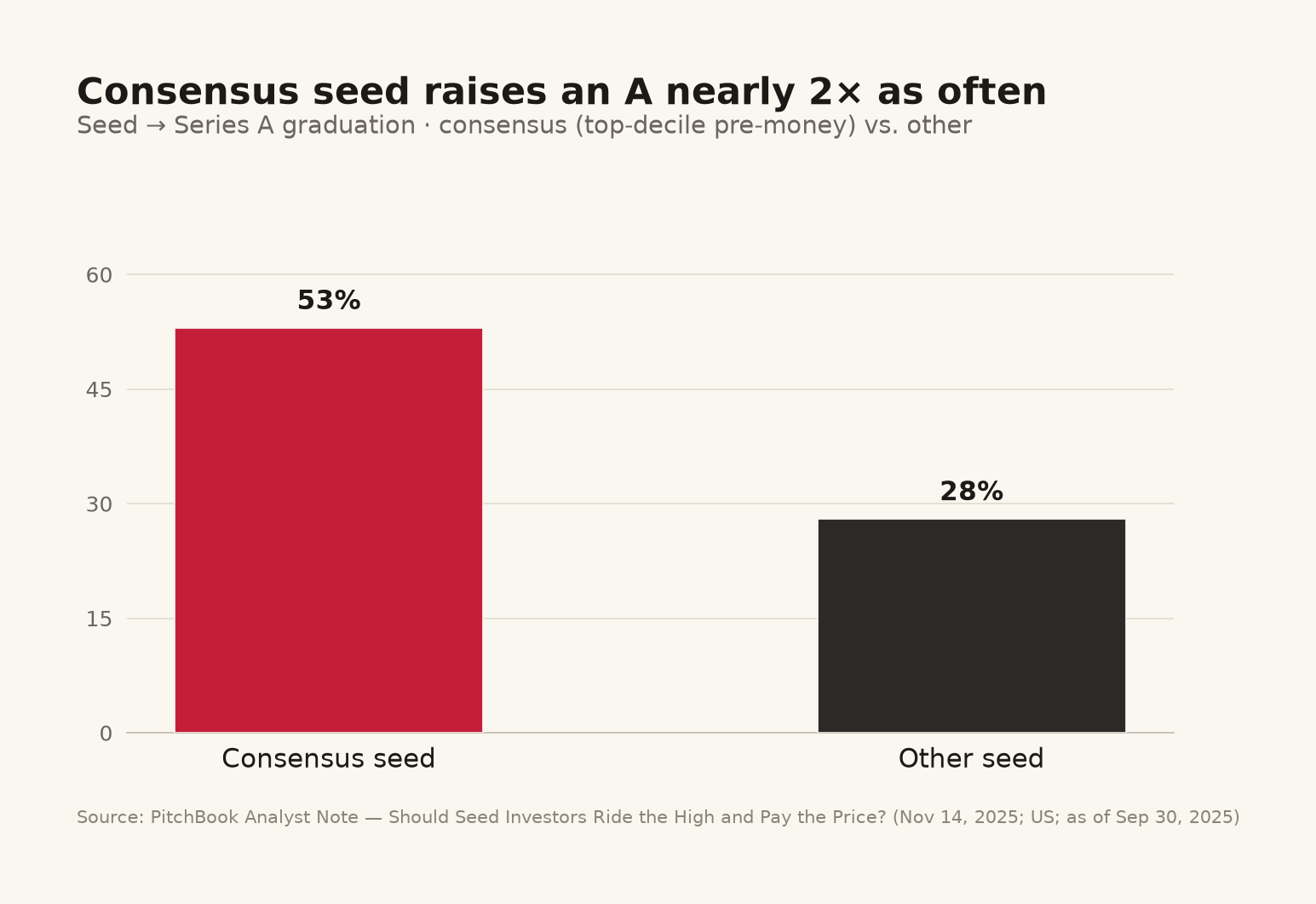
PitchBook's Q4 2025 seed note: 53% of consensus (top-decile pre-money) seed deals went on to raise a Series A, versus 28% for everyone else. And when it came to defending ownership, a seed investor led a later round in 25% of consensus deals (peak around 2020) versus a steady ~10% for other rounds.
Reserving 40–60% of the fund for follow-ons is a bet that you'll be in the 53%/25% cohort — not the other one. Pro rata without reserves is a right you can't exercise. Pro rata with reserves into non-consensus names is how funds get stuck.
Implication: decide which companies you're willing to defend before the A process starts. The rest get a polite pass, not a half check.
Source: PitchBook Analyst Note, "Should Seed Investors Ride the High and Pay the Price?" (Nov 14, 2025; US data as of Sep 30, 2025).
The tactic
Ask for your reserve number six months out
About six months before your A, ask each existing investor: "What did you reserve for us at the initial check, and where would you put us today?" Then ask what would move you up.
Find out each fund's vintage, how much it has deployed, and whether it has been writing follow-ons lately.
Size the round around the real numbers, not around "we're very supportive."
Failure this prevents: Prevents a $1.25M gap nobody planned for, discovered the week the term sheet arrives.
The rethink
Used to: A seed lead skipping its pro rata was a real negative signal about the company.
Now: Fund age and remaining reserves explain most skipped pro rata. Where the fund is in its life usually matters more than how the company is doing.
What moved: Going back through Series A rounds where the seed lead sat out and sorting them by the seed fund's vintage. Once I controlled for fund age, most of the signal went away, because the older funds were skipping across their whole portfolio. I'd change my mind if follow-on rates still predicted outcomes after that adjustment.
Views are my own, not Alumni Ventures'. Nothing here is investment advice. Deals and companies are anonymized unless already public.