
The essay
So You're Taking a Deal to IC…
If you've ever sponsored a deal at investment committee, you know how it goes. You've spent six weeks with the founder, built the model, and called customers, and by now you really want to do the deal. Then you get into the room and the partner who pushes back hardest is the one who never took a single call. That's actually how it's supposed to work. The point of a committee is to have someone with no context read your memo cold and ask the question you haven't fully answered.
Good companies get turned down at IC all the time, and usually it isn't because of the company. It's because the memo didn't answer the questions the committee cares about. So what is the committee looking for, and how do you write a memo that holds up?
What the Memo Is For
The committee doesn't need the founder's pitch again with more detail. The memo exists so a skeptical partner can answer two questions in about ten minutes. First, what's the most likely way this fails? Second, does the return math work for this fund at this price?
Most memos spend eight pages on why the company is great and get to those two questions late, if they get there at all. When that happens, the committee starts asking them for you, and the meeting goes wherever they take it.
The Math Nobody Puts on Page One
Here's an illustrative case. A $100M fund is looking at a $4M check at a $40M post-money valuation. That's 10% ownership on day one, and 10% is the number that usually shows up in the memo.
The first thing a cold reader asks is what that looks like after dilution. After two or three more rounds, the fund might own something like 6% at exit if it doesn't keep buying. Now run the numbers:
-
To return the whole fund from this one company at 6%, it needs to exit at about $1.67B.
-
To return a third of the fund, it needs to exit at about $550M.
-
For comparison, at 10% you'd need $1B, and at 4% you'd need $2.5B.
Where you land: the real question is whether this company can plausibly get to a $1.5B+ outcome, and where in the memo the evidence for that lives. If the market size, the comps, and the growth plan don't support it, the deal is priced wrong for this fund. It could still be a good business. It just isn't the right deal for a $100M fund at this price. Experienced partners do this math in their heads in the first couple of minutes. If your memo makes them do it themselves, you've lost some credibility before the real discussion even starts.
The Failure Line
Every company has one assumption that matters more than the others. Customers renew in year two. The channel partner keeps sending deals. Inference costs stay low enough to serve customers at the current price. Gross margin gets above 60% at scale. There's always one.
If your memo names it, the committee spends the meeting on evidence: customer calls, cohort data, pilot conversion. That's a useful meeting. If your memo doesn't name it, someone in the room will, usually starting with "so what happens if…" Now you're answering on the spot about a risk you've probably thought about but never wrote down. The committee will assume you either missed it or left it out on purpose, and neither one helps you get the deal approved.
Three Other Things the Committee Looks At
Who passed, and why. "They didn't get it" isn't a reason. If two good firms looked at the deal and passed, the committee wants to know what they saw.
What's missing. Cohort data that never came, a reference the founder steered you away from, or a cap table with a messy SAFE stack (see Part 3).
What happens after the check. A $4M first check with nothing reserved behind it is a different bet from $4M with another $4M in reserve, and the committee is really approving both. If the company needs $3M of ARR for a clean Series A and the plan gets there in 24 months on 18 months of runway, that six-month gap is the real issue. It's often buried on page nine.
Final Thoughts
IC doesn't like surprises, and the best way to avoid one is to bring it up yourself. Put the biggest risk at the top of the memo, show the math at the ownership you'll really have, and let the committee argue about evidence instead of guessing at what you left out.
The chart
Outside top-decile seed, ~39% of deals go to zero
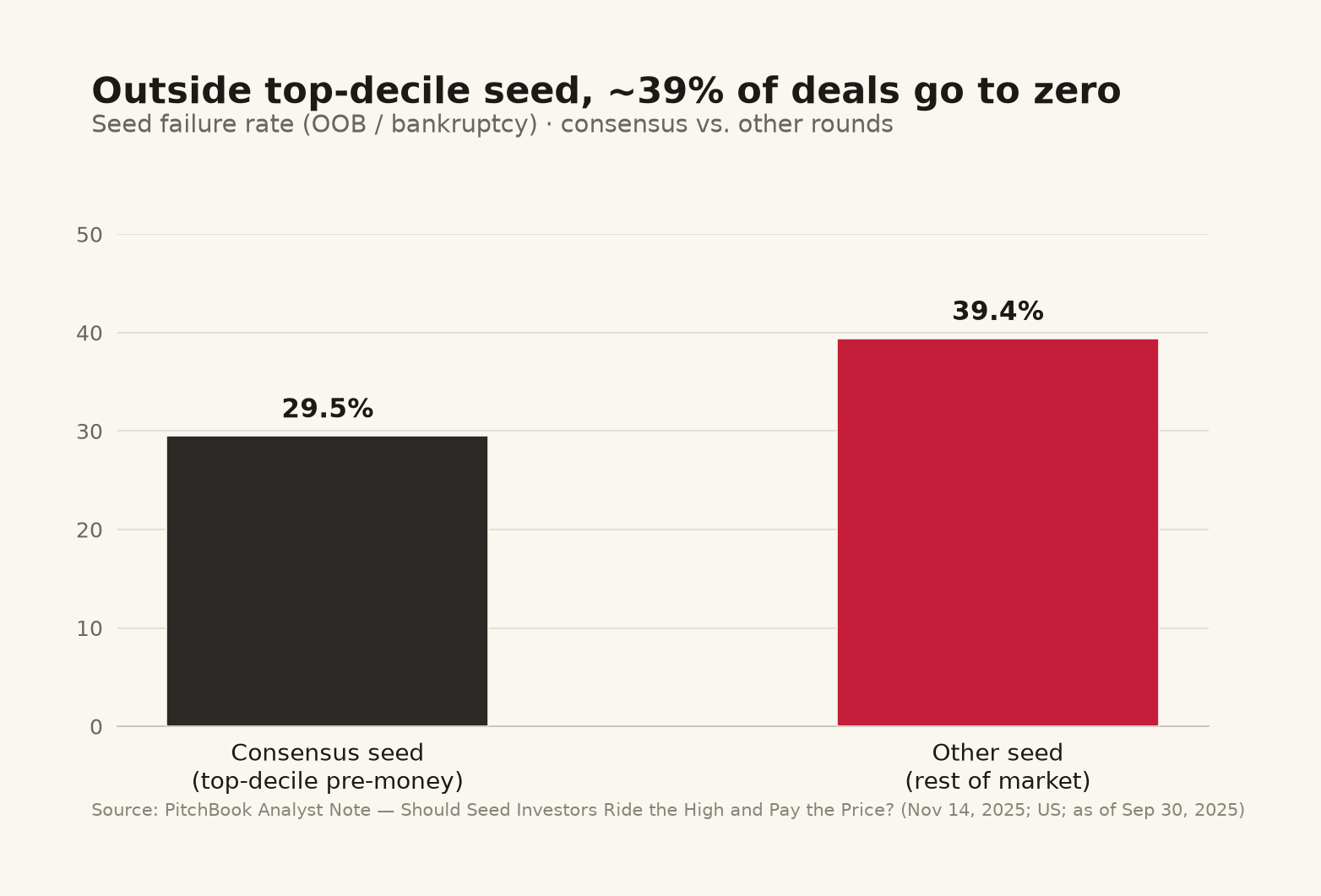
PitchBook's November 2025 note finally replaces the old Correlation Ventures slide everyone still quotes. Across US seed deals with exits observed through 2025, consensus rounds (top-decile pre-money for their deal year) fail at 29.5%. The rest of the seed market fails at 39.4%. Consensus also shows roughly 10% 10x+ outcomes versus about 5% elsewhere — and annualized returns of 35.3% vs 22.5%.
IC is not killing "good" companies for sport. A deal that can't clear ownership math into a plausible fund-returner fails the distribution before the partner vote. The bar is the power law, not the pitch.
Implication: walk into IC with the exit that makes the fund work at this ownership, or don't take the meeting.
Source: PitchBook Analyst Note, "Should Seed Investors Ride the High and Pay the Price?" (Nov 14, 2025; US data as of Sep 30, 2025).
The tactic
Write the failure line first
Above the thesis, put one sentence: "This fails if ___." Write it before anything else in the memo, before you get more attached to the deal.
Right under it, show the exit value needed to return the fund at the ownership you'll actually hold at exit, not on day one.
End with what would prove you wrong and which signals you'll watch after the check.
Failure this prevents: Prevents the committee finding the biggest risk halfway through the meeting and deciding you either missed it or left it out.
The rethink
Used to: Deals got through investment committee mostly on the sponsor's conviction.
Now: Deals get through mostly on whether the memo names its own failure line and shows the return math at diluted ownership. Conviction helps, but it doesn't answer the question the committee is asking.
What moved: Rereading a stack of IC memos next to the notes from the meetings. The deals that stalled weren't the ones with the least enthusiastic sponsor. They were the ones where a partner found the biggest risk before the memo did. I'd change my mind if a firm's own IC records showed conviction predicts approvals better than memo clarity.
Views are my own, not Alumni Ventures'. Nothing here is investment advice. Deals and companies are anonymized unless already public.